In 2013, global renewable electricity generation rose by a n estimated 240 terawatt hours (TWh) (+5.0% year-on-year) to reach nearly 5 070 TWh and accounted for almost 22% of total power generation. The expansion was somewhat slower than that predicted in the Medium-Term Renewable Energy Market Report 2013 (MTRMR 2013), largely due to lower-than-expected annual hydropower availability and slower-than-expected growth in bioenergy generation. However, the renewable capacity expansion was faster than that foreseen in MTRMR 2013, with larger-than-expected deployment of hydropower and solar PV. NOTE - This report includes big hydro power and biofuels (including ethanol) which are still the biggest part of renewable energy. By 2020 though Wind gets to be about 19% of the total renewable and wind will be near 50% of what nuclear energy generation will be. Overall, global renewable electricity generation is expected to reach 7,310 TWh in 2020, representing an annual growth rate of more than 5.4 percent. When compared to the MTRMR 2013 estimates, the IEA notes that the outlook for bioenergy and several other technologies is less optimistic. For that reason the renewable generation forecast for 2018 is 180 TWh lower than in last year’s outlook. In particular, an executive summary of the report points to a slower growth for bioenergy in China. Moving forward bioenergy capacity is expected to expand steadily in Brazil. It is also expected to increase in India and other parts of Asia. Global bioenergy capacity is expected to increase from 88 GW in 2013 to 133 GW in 2020. By 2020, the report predicts there will be 2,555 GW of renewable energy capacity globally. In addition to the 88 GW of bioenergy capacity, this includes 1,360 GW of hydropower capacity, 630 GW of wind capacity, 403 GW of solar PV, 11 GW of solar thermal, 16 GW of geothermal and 1 GW of ocean.
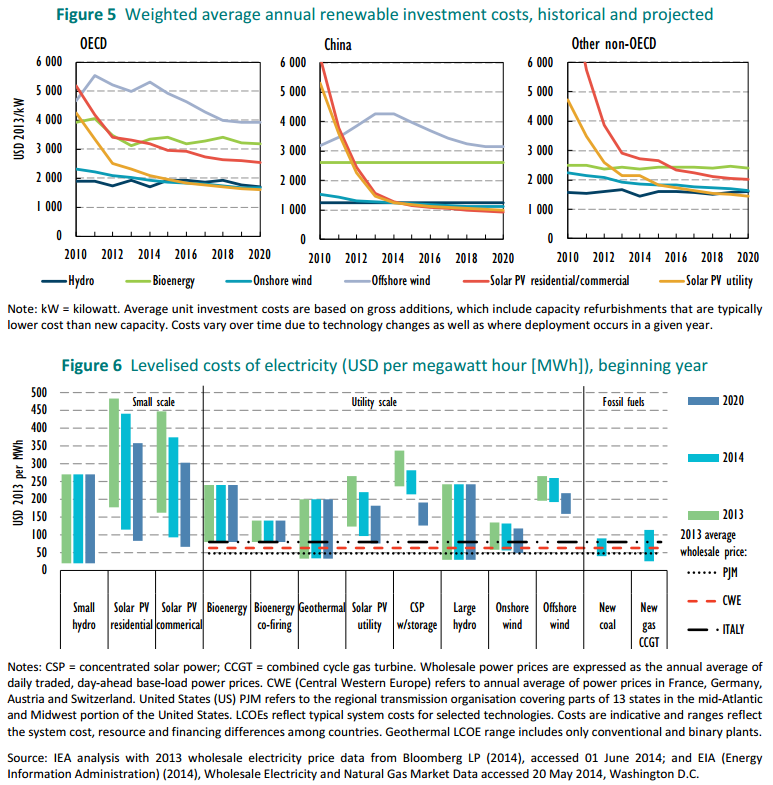
Clean energy capacity investment will still rise to $1.61 trillion by 2020. But in its first global investment outlook, the agency predicted a $20 billion drop in yearly new clean energy funding by the decade’s end to $230 billion. The new 2018 estimation is for global renewable energy is 5,505 TWh, compared to last year’s estimate of 6,850 TWh. Growth forecasts were lowered for all renewables, except solar PV, which should benefit from technology cost declines and rapidly scaled-up deployment in non-OECD markets.
In transport, the IEA notes that global biofuels output must triple and advanced biofuels need to increase 22-fold to meet climate goals by 2025. However, policy support is declining due to the need for securing sustainable feedstock sources. The industry is currently in limbo, ahead of EU adoption of a proposal on indirect land use change (ILUC) that may cap conventional biofuels use.
The 2014 IEA world energy forecast including all energy sources. If you liked this article, please give it a quick review on ycombinator or StumbleUpon. Thanks